

Different Types of High-Voltage Testing Machines and Their Uses
A high-voltage testing machine is one component of a high-voltage test device that combines the functionality of a voltmeter and an ammeter. Such a machine is applied in the simulation of extreme electrical conditions, calibrating the strength, insulation, and safety of components for high-voltage testing.
From testing whether a circuit breaker testing withstands a more than moderately strong power surge to testing if a traction motor is reliable during high-speed running in a train, the types of high-voltage testing machines are as diverse as their applications. In India, where infrastructure and industrialisation are booming, choosing the correct HV testing machine is critical for businesses that want to acquire a distinctly global value system while keeping costs in check.
Crest Test Systems, a leader in test and measurement solutions, is spearheading the charge by providing innovative high-voltage testing machines to industries across the globe. In this excerpt, we’ll examine the applications of different kinds of high-voltage testing machines, integrating them with the know-how of the industry.
What is a High Voltage Testing Machine?
A high voltage testing machine is a piece of equipment that applies high voltage to electrical parts to test their insulation, performance and safety. Such machines are essential for industries like power distribution, manufacturing, and transportation, where the equipment is required to function reliably under high voltage.
Handling volumetric high voltage, such as >1,000 V AC or 1,500 V DC, is a special forte for the machine. Crest Test Systems, incorporated in 2009, deals with automated HV testing machines which guarantee IEEE compliance and other automated international standards set by IEC.
The high voltage testing machines have unique designs poised to perform specific tasks. Their classification is based on test voltage range, the equipment tested and the type of test performed. Each design is crafted to address industry requirements for ease and accuracy in safety and standards enforcement of system reliability out of routine maintenance and robust type testing.
Different Types of High-Voltage Testing Machines and Their Uses
1. AC High Voltage Testers
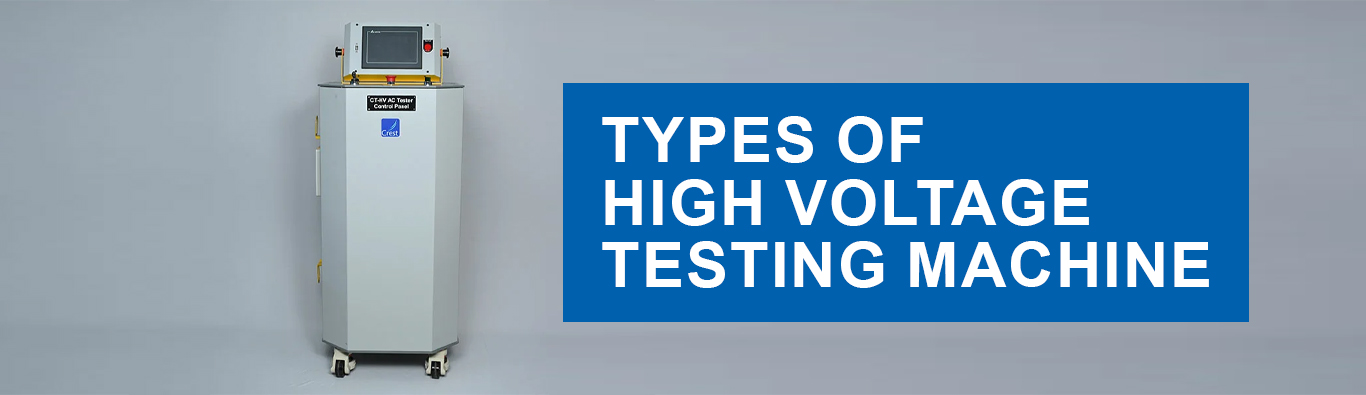
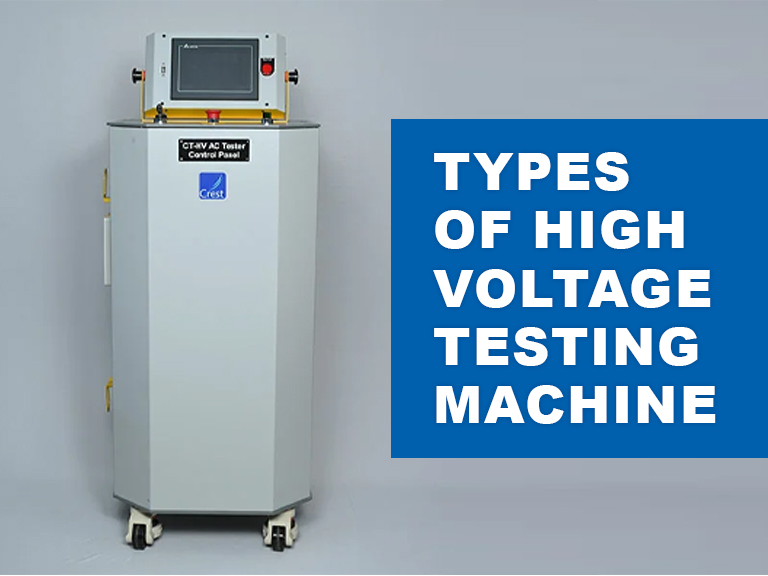
As the name suggests, AC testers apply alternating current (AC) at high voltage to test the insulation strength and dielectric properties of a component. Crest Test Systems’ CT-HVT Series is a good example, as it can test up to 100 kV RMS at 50 Hz, having significant output current for high capacitance loads such as cables and transformers. These HV testing machines have touchscreen and digital control interfaces that allow fully automated test cycles with results stored for further analysis.
2. DC High Voltage Testers
DC high voltage testers apply direct current (DC) to check the strength of insulation in equipment associated with high voltage direct current (HVDC) systems, which are increasingly found in renewables or rail network systems. DC testers from Crest Test Systems are available for medium voltage networks, including paper-insulated cables, with controllable and accurate voltage settings.
At Crest Test Systems, we have introduced a new product called HVCT80. This high-performance DC high-voltage tester performs tests up to 80 kV, designed for reliable insulation testing in modern HVDC applications.
3. Impulse Voltage Testers
Impulse voltage testers simulate lightning strikes or switching surges to evaluate the durability of high-voltage equipment under transient conditions. These testers are crucial for assessing components such as transformers and insulators. While Crest Test Systems does not currently manufacture these systems, we can procure and supply them through their OEMs, ensuring quality and performance for your specific testing needs.
4. Partial Discharge (PD) Testers
PD testers help detect early-stage insulation defects that can lead to future failures. They offer non-destructive testing for cables, joints, and terminations, and help in pinpointing fault locations for proactive maintenance. Although not part of our standard product lineup, Crest Test Systems can source these testers directly from OEMs to meet client requirements.
5. Tan Delta/Power Factor Testers
Used for assessing dielectric losses, tan delta testers indicate insulation ageing or degradation in power systems. These tests provide insight into the health and remaining life of insulation in cables, transformers, and rotating machines. While not part of our in-house offerings, Crest Test Systems can arrange for high-accuracy tan delta testers from trusted OEM partners.
Uses of High-Voltage Testing Machines
High voltage testing machines have an array of uses across different sectors and fields that include:
- Power Transformers: These power transformers are tested to check their energy transfer and insulation efficiency.
- High Voltage Cables: Physical testing of the cable’s insulation and the joints is done to confirm performance.
- Switchgear and Circuit breakers: Testing the devices for their dielectric strength and mechanical operations.
- Motors and Generators: Test them for insulation resistance and operation reliability.
- Research and Development: Studying and examining the efficiency and reliability of a prototype under high voltage.
Conclusion
High voltage testing machines, such as AC and DC testers, impulse, partial discharge, and tan delta testers, are essential in confirming electrical equipment’s safety, reliability, and performance.
Crest Test Systems’ high voltage test equipment is helpful whether you are developing a smart city, running a railway system, or even producing transformers. Our equipment is automated, accurate, and up to international standards, assisting various industries.
Discover our product solutions and select the perfect fit for your testing requirements. Get in touch with us now.
FAQs:
AC Hipot testers, DC Hipot testers, impulse testers, partial discharge testers, and insulation resistance testers.
Power, manufacturing, automotive, railways, and electrical equipment testing.
Use protective gear, ensure grounding, follow lockout-tagout procedures, and maintain safe distances.
In labs, factories, substations, and R&D centres to test cables, transformers, motors, and switchgear.