

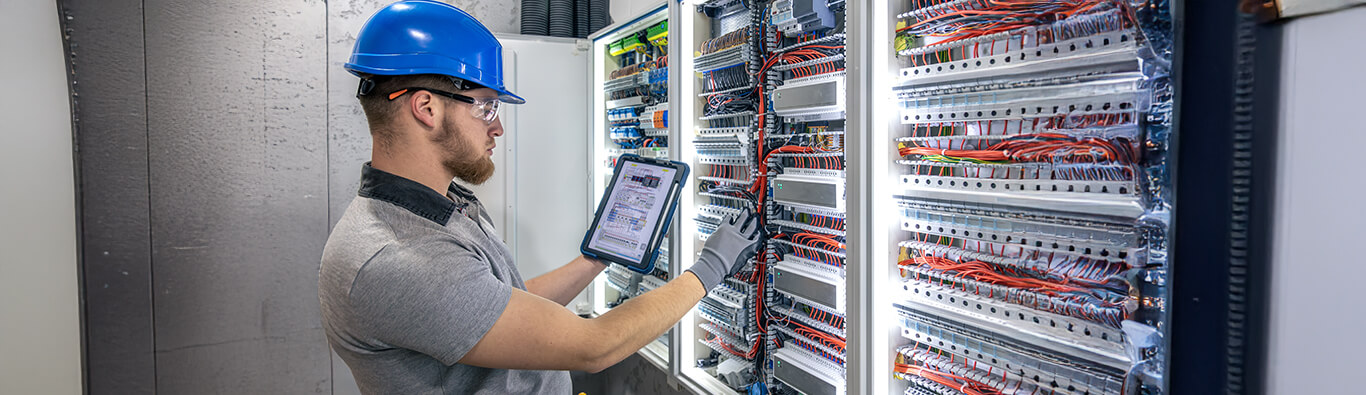
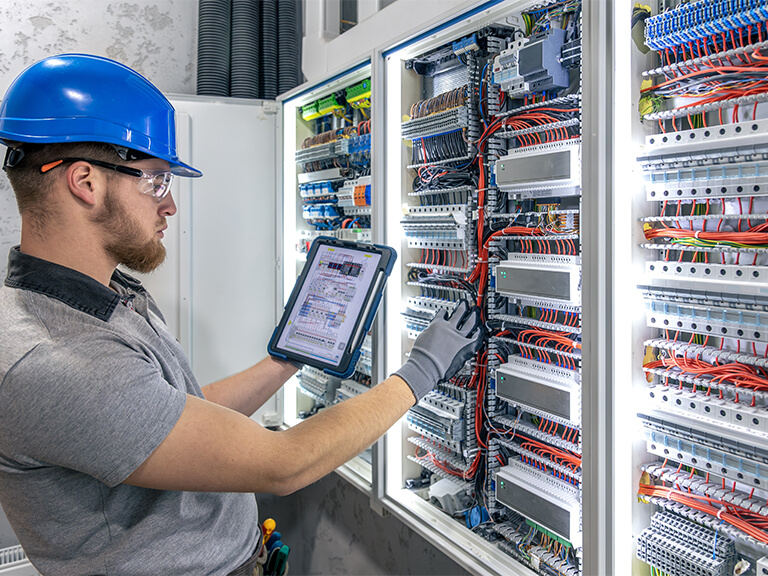
Circuit Breaker Panels for Renewable and Hybrid Power Systems
Renewable and hybrid power plants work differently from traditional grids. Power does not always move in one direction. Solar panels send energy into inverters, batteries store or release it, and sometimes the grid or a generator steps in to fill the gap.
In all these changes, circuit breaker panels play a key role. They keep the system safe by isolating faults, managing protection, and helping maintain continuous operation. These panels act as the main safety layer in a renewable setup, ensuring nothing goes wrong when power changes paths.
At Crest Test Systems, our focus is not on building these panels but on creating the test systems that make sure they work safely, accurately, and according to global standards before they are installed.
What Makes These Panels Unique
A circuit breaker panel used in renewable or hybrid projects is built differently from the ones used in commercial or residential setups. Here is why.
1. Power flows in both directions.
Renewable System Components – Renewable systems allow electricity generated via solar panels or batteries to flow from a grid and back to the grid during charging.
2. They handle both DC and AC power.
Solar panels and batteries produce direct current (DC) power, while grid systems and nearly everything else use alternating current (AC). Therefore, breaker panels need to support both types of power and mitigate the potential for dangerous levels of electrical energy arcing associated with the operation of a DC circuit.
3. They must meet strict international standards.
Panels used in industrial and renewable power applications follow IEC 61439. This covers temperature rise, dielectric strength, short-circuit performance, and insulation integrity.
4. They must support inverter safety systems.
An inverter takes DC power from a solar panel or battery and converts it to AC. The inverter is governed by IEC 62109 for safety and IEC 62116 for anti-islanding testing. Breaker panels have to communicate effectively with both solar panels and the electric utility to guarantee total protection.
Main Components Inside a Breaker Panel
A typical renewable or hybrid breaker panel will include:
- Main Breakers and Feeder Breakers – These devices control power flow and observe any faults in the electrical system.
- DC Isolator/Breakers – These devices help create a connection between your solar array and battery bank in a safe fashion.
- Surge Protection Devices – Protect your system against voltage spikes and lightning strikes.
- Interlocks – Devices that prevent you from accidentally operating the system while in Maintenance Mode.
- Monitoring Systems – Monitoring systems include current transformers, voltage sensing devices, and meters interfaced with your SCADA system to provide real-time information about your renewable system. The breaker panel must protect the system regardless of the direction of current flow.
Where Crest Comes In
Crest does not manufacture breaker panels. We build test systems that ensure those panels are safe and reliable before they reach the site.
Our offering includes the Panel Test System, an integrated, all-in-one solution designed for comprehensive testing of electrical panels and circuit breakers.
The system enables manufacturers to:
- Verify circuit breaker performance, including breaker timing, coil and motor current, and mechanical movement.
- Conduct high-voltage (HiPot) testing to confirm that panel insulation can safely withstand its rated voltage.
- Perform endurance and mechanical cycling tests by simulating thousands of open and close operations, ensuring circuit breakers can withstand prolonged and intensive use in demanding hybrid and renewable energy applications.
By combining all these test capabilities into a single platform, the Panel Test System simplifies panel testing workflows while ensuring consistency, accuracy, and compliance with relevant standards.
Key Areas Tested in Renewable and Hybrid Panels
If you are preparing a test plan or commissioning checklist, these areas need close attention.
- Dielectric Withstand Test (Insulation Resistance) Checks a cable’s insulation/shielding to identify weak spots at high voltage levels.
- Breaker Timing Test (Opening and Closing Times) Ensures that a breaker opens/closes within the determined time period.
- Contact and Bus Resistance (Resistance at the Joint) Tests for a good connection between wires and bus bars so that the electrical path is as efficient as possible. High-resistance areas in a circuit can produce excessive heat.
- Protection Logic and Interlocks (Protection Logic Test) Tests how the system reacts when a breaker(s) is used in conjunction with several different modes of operation: grid-assisted use, battery-only use, and stand-alone mode (off-grid).
- Test Records and Documentation Each of the above tests should be documented and connected to the particular panel for tracking purposes during inspections/audits.
Choosing the Right Breaker and Testing Method
Low-voltage MCCBs and ACBs are used in feeders and main panels. They are tested for trip timing and protection accuracy.
DC breakers and isolators are used on the solar and battery side. These are tested for contact resistance and dielectric strength since DC faults behave differently from AC faults.
Medium-voltage VCBs are found in larger hybrid plants. They need timing, motion, and endurance testing before installation.
Crest’s testing systems are designed to handle all of these checks, giving manufacturers consistent, repeatable results.
In Summary
Protection against electrical fault conditions for hybrid and renewable Energy systems is provided by breaker panel safety and stability, while the reliability of electrical breaker panel safety and stability depends on formal and certified testing.
Crest Test Systems designs and manufactures advanced testing equipment used to validate the performance and safety of circuit breakers and related electrical components. Crest’s solutions help manufacturers ensure compliance with government standards while maintaining the long-term efficiency and reliability of power distribution systems.
FAQs:
A Circuit Breaker Panel is a piece of switchgear that provides an organized system for managing safe power distribution from the source (solar array, batteries, grid, and generator).
A breaker panel controls and manages the power being transferred from multiple sources in a hybrid energy system while providing the necessary protection when changing between operational modes.
A breaker panel prevents failure from spreading into adjoining circuits, protects other equipment connected to the system, and allows maintenance workers to work safely.
When selecting a breaker, determine current level, voltage type, and application; then test your breaker using an appropriate testing device prior to use.