


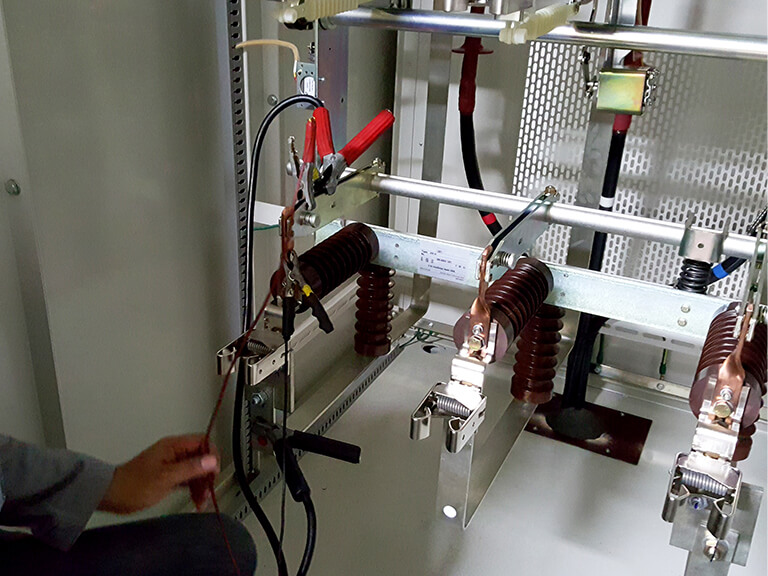
How Rising Contact Resistance Impacts Circuit Breaker Performance
Most breaker failures don’t start with a loud bang. They start with a number that slowly creeps upward. That number is Contact Resistance.
At first, the change is microscopic. A few micro-ohms higher than last year. Nothing dramatic. The breaker still passes a basic functional check.
But inside the contacts, heat begins to build. And heat, in power equipment, is rarely harmless.
Understanding how contact resistance in circuit breakers evolves, and how to measure it properly using Dynamic Contact Resistance Measurement, is essential for anyone responsible for breaker reliability.
What Contact Resistance Really Means
When a breaker is closed, current flows across mating contact surfaces. Ideally, those surfaces provide a low-resistance path.
In reality, the interface is never perfect. Even polished contacts have microscopic irregularities. Pressure, alignment, and surface condition determine how effectively current passes through.
Contact Resistance is the small electrical resistance at that interface. In healthy breakers, it remains low and stable. When it starts rising, performance begins to drift.
The Effects of High Contact Resistance
According to basic power loss principles, heat produced at the contact is proportional to current squared multiplied by resistance. In medium- and high-voltage systems carrying significant load, even a small increase in resistance can produce a noticeable temperature rise.
The effects of high contact resistance include:
- Localised overheating.
- Accelerated contact wear.
- Insulation degradation nearby.
- Increased mechanical stress.
Left unchecked, this turns into one of the most common circuit breaker overheating issues seen in substations.
Why Overheating Is a Serious Concern
Overheating rarely stays confined to the contact surface. When the temperature increases:
- Softening of contact materials.
- Pressure reductions from springs.
- Increased aging and degradation of adjacent insulation.
- Differential expansion of metal components.
Eventually, thermal stress will change the geometry of contacts and increase the resistance to current flow. This is known as a feedback loop.
When the temperature rises too high, there is the potential for the welding of electrical connections or catastrophic failures of electrical connections during loading conditions.
Can Rising Contact Resistance Affect Performance Before Failure?
Yes, it can, and this is where most of the risk occurs.
It would still work mechanically, but the ability of each breaker to operate properly will decline. Here are some examples of what happens as a result of increased contact resistance.
- An increased voltage drop across the contacts.
- Increased energy losses.
- Decreased protection coordination margins.
- Inconsistent trip response under fault conditions.
Thermal protection devices can be activated due to overheating or contribute to nuisance operations. The breaker appears operational, but no longer optimal.
Circuit Breaker Contact Resistance Testing
For regular circuit breaker contact resistance testing, engineers perform micro-ohm testing with low voltage and high amperage by applying electric current to the circuit breaker’s contacts. Results include data that indicate:
- How much resistance is in the circuit breaker contacts
- The percentage difference between phases
- How much the phase-to-phase contact resistances have changed in comparison to previous years
The trending data is critically important. A slight increase over several years is more significant than a single isolated reading.
Dynamic Contact Resistance Measurement: Why It Matters
Static measurements tell you the resistance when the breaker is fully closed.
Dynamic Contact Resistance Measurement (DCRM) goes further. It measures resistance while the breaker is opening or closing.
This allows engineers to detect:
- Irregular contact travel.
- Erosion patterns.
- Transitional arcing behaviour.
- Loss of effective contact pressure during motion.
Dynamic measurement is especially useful in high-voltage breakers, where internal contact assemblies are not visually accessible.
It reveals problems before they become visible.
Early Detection and Grid Reliability
Rising contact resistance doesn’t just affect one breaker. In a transmission or distribution network, it increases system stress.
High-resistance contacts generate heat that can:
- Damage adjacent components.
- Shorten maintenance intervals.
- Increase outage probability.
From a broader perspective, controlling supports overall grid stability.
Standards issued by the International Electrotechnical Commission require periodic verification of breaker conditions, including resistance checks.
Always measure to guarantee compliance (with the applicable code or standards), but also to assist in identifying progressive deterioration before it becomes severe.
What Is the Function of a Structured Testing System?
Engineers performing a resistance test must conduct both the current flowing during the resistance test and record the measured resistance in an appropriately controlled manner.
Crest Test Systems supports manufacturers and utilities through its AutoScan PA9600 Circuit Breaker Analyser, which integrates:
- Static contact resistance measurement.
- Dynamic Contact Resistance Measurement capability.
- Timing and motion analysis.
- Coil current measurement.
Bringing these parameters together allows engineers to correlate resistance drift with mechanical behaviour and timing performance, rather than reviewing each in isolation. That integrated view reduces blind spots.
Conclusion
Rising Contact Resistance is rarely dramatic at first. It creeps upward, quietly increasing heat and stress inside the breaker.
By the time visible symptoms appear, damage has already begun. Engineers need to perform both static testing and dynamic contact resistance testing on circuit breakers to detect potential problems before they escalate into circuit breaker failure due to overheating.
In high-energy power systems, reliability depends on attention to small deviations. Contact resistance is one of those small numbers that carries large consequences.
Managing it carefully strengthens both breaker performance and overall grid reliability.
FAQs:
It is the small electrical resistance at the interface between closed breaker contacts.
Oxidation, wear, pitting, reduced contact pressure, misalignment, and contamination.
It increases heat generation, accelerates wear, and can reduce overall operational reliability.
Because excess heat damages contact materials, insulation, and mechanical components over time.
Yes, excessive heat or voltage drop may affect protection coordination and trigger unintended operations.
Using high-current injection methods for static testing and Dynamic Contact Resistance Measurement during operation.
Values vary by breaker type and rating, but typically remain in the low micro-ohm range and should be stable over time.
It increases the risk of overheating, component degradation, and unexpected outages.
Yes, through routine trending of static and dynamic resistance measurements.
By performing periodic resistance testing, monitoring trends, and addressing mechanical or alignment issues promptly.