


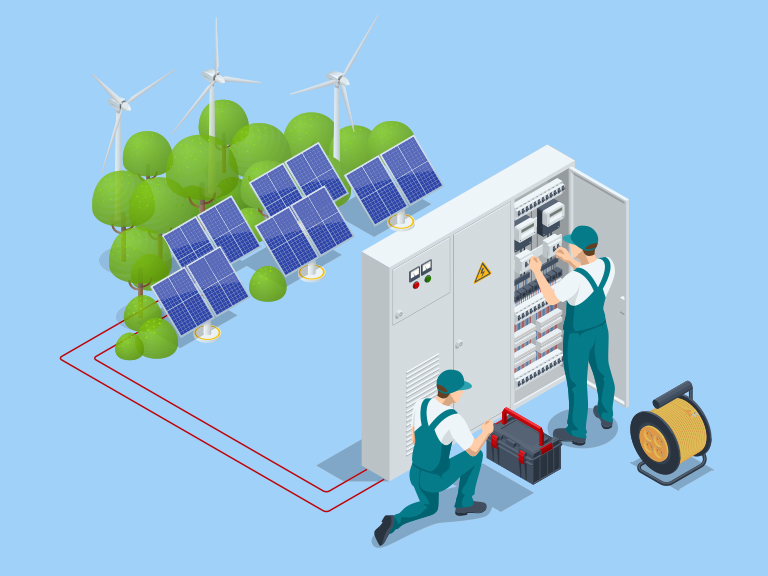
Circuit Breaker Panels for Solar Power Systems
A circuit breaker panel is the central hub that safeguards and distributes electricity in any system, especially in solar power systems. This panel, essential for both safety and efficiency, includes breakers on both the DC (direct current) side, which connects to the photovoltaic (PV) array, and the AC (alternating current) side, which directs power into your building or back to the grid. Breakers are crucial for disconnecting power during maintenance and protecting equipment from overloads, short circuits, and faults.
Whether designing a small residential system or a large-scale commercial installation, selecting the correct circuit breaker for solar panel setups is critical for long-term performance and safety.
Types of Breakers in Solar Systems
Solar power systems typically use two distinct types of breakers:
- DC Circuit Breakers for Solar Panels: These handle the high-voltage direct current generated by the PV array. Found in combiner boxes, these breakers isolate PV strings and help extinguish dangerous DC arcs. Most are UL 489 B-compliant and rated up to 1500 VDC.
- AC Breakers are standard breakers (MCBs or MCCBs) used on the inverter output side. Installed in the AC breaker panel solar power system, they manage alternating current flowing into the building or utility grid.
Example: A residential system might include string level DC breakers in the combiner box and a 30 A AC breaker connecting the inverter output to the home’s main distribution panel.
Sizing and Code Requirements
Correct sizing ensures the circuit breaker for solar power is safe and compliant with regulations:
- 125% Rule: The PV breaker must be rated for at least 125% of the inverter’s continuous output current. For example, a 32 A output requires a 40 A breaker.
- 120% Rule: Per NEC 705.12, 125% of the inverter output plus the main breaker rating should not exceed 120% of the panel’s busbar rating. A 200 A panel allows a 40 A solar breaker if the main breaker is also 200 A.
Most residential solar systems operate safely within a 200 A breaker panel. A dedicated panel may be necessary for higher-capacity solar systems, especially commercial ones.
Installation Best Practices
When installing a solar power circuit breaker, best practices include:
- Breaker Placement: Install solar breakers at the opposite end of the main breaker within the panel to meet NEC code.
- Accessible Disconnects: Include both DC and AC disconnects near the combiner box and the inverter. These are critical for maintenance and emergencies.
- Rated Enclosures: If installed outdoors, use weatherproof and solar-rated panels. All breakers and enclosures must meet the environmental and voltage specifications.
- Grounding and Labeling: Proper bonding and clear labeling of PV conductors and breakers ensure system safety and simplify troubleshooting.
- Testing and Verification: After installation, test all breakers for correct trip settings. Crest Test Systems offers reliable testers to help ensure that every circuit breaker for solar panel setups performs as expected.
Maintenance and Safety Inspections
Circuit breaker panels in solar installations should be inspected and maintained regularly. This typically includes:
- Annual Visual Inspection: At least once per year, or as the manufacturer recommends, visually inspect the panel for loose connections, corrosion, or water ingress. Tighten any loose terminals and ensure breakers are correctly seated.
- Thermal Imaging: Use infrared scanning to detect hot spots, indicating overloading or loose connections.
- Functional Testing: Trip breakers should be tested periodically to confirm they are operational. Many codes require testing critical safety devices (e.g., ground-fault or arc-fault breakers) during routine maintenance.
- Panel Cleaning: Keep the panel’s interior and enclosure clean and dust-free. Make sure ventilation or air gaps (if any) are not obstructed.
Regular maintenance helps prevent faults or overheating that could lead to system shutdowns or hazards. By ensuring the proper functioning of your circuit breakers, you can maintain the efficiency of your solar power system for years to come.
Conclusion
By following proper design, installation, and maintenance practices, you can ensure that your solar circuit breaker panel operates safely and efficiently for decades. This knowledge empowers you to make informed decisions about your solar power system.
If you’re designing or upgrading a solar installation, ensure long-term safety and efficiency with the proper testing tools. Crest Test Systems offers advanced circuit breaker testers to support high-performance solar applications. Contact us today to explore our solutions.
FAQs:
DC circuit breakers are used on the photovoltaic (PV) side to handle direct current. In contrast, AC circuit breakers are installed on the inverter output side to manage alternating current supplied to the grid or building loads.
It protects the system from overloads, short circuits, and faults and allows for safe disconnection during maintenance or emergencies, ensuring the safety of both equipment and personnel.
The size depends on the inverter capacity and load demand, but most residential systems typically require 200 A panels to meet code and backfeed allowances.
Breaker panels should be inspected annually, with more frequent checks in dusty, humid, or outdoor environments to ensure reliable performance and safety.