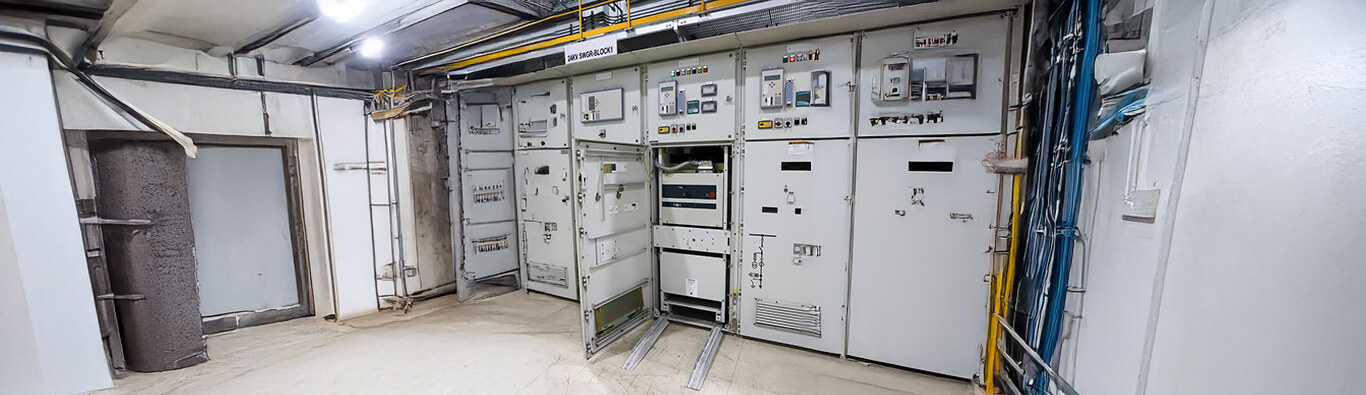
Importance of VCB Panel Testing for Electrical Safety
Home + Blog + Importance of VCB Panel Testing for Electrical Safety

Importance of VCB Panel Testing for Electrical Safety

The Vacuum Circuit Breaker (VCB) panel is the essential control center for medium-voltage electrical distribution. When a VCB performs correctly, it keeps people safe and protects valuable equipment.
When a VCB does not trip when it’s needed, it results in hazards — in particular, arc flash hazards, unplanned extended outages, and expensive damage that requires repairs. VCB panel testing is therefore non-negotiable; it’s the only way to confirm the panel will reliably interrupt the circuit when a devastating fault current occurs.

What A VCB Panel Does And Why It Matters

A vacuum circuit breaker (VCB) panel houses the breaker, protection relays, metering, and interlocks that control feeders and transformers in the 3.3–36 kV range.
The VCB’s core function is simple to state but difficult to guarantee: it must detect a fault, open the circuit cleanly, contain the resulting energy, and return to service without issue. Testing isn’t about assuming that the critical sequence works; it’s the absolute proof that your panel will perform precisely when a fault current hits.

Standards That Define Safe Operation

Well-built VCB panels are designed and validated against established switchgear standards. In practice, that means:
  • Construction and assembly verified for dielectric strength, temperature rise, short-time withstand, and internal-arc containment.
  • Breakers are validated for making and breaking duties, mechanical endurance, and electrical endurance.
  • An internal arc classification that specifies safe exhaust paths so operators can stand where it’s safe during faults.

Critical VCB Panel Testing Types

Test Type

Description/Focus

Key Tests Included

Primary Outcome

Type Tests

Design-level proofs on representative units. Validates the fundamental engineering of the panel.

Impulse and power-frequency withstand, temperature rise, short-circuit withstand, and internal-arc containment.

Confirms the design is fundamentally sound and safe for deployment.

Routine Tests

All panels manufactured are to be pretested.

Verifying wiring continuity, interlock operation, power frequency withstand, mechanical operation, and accuracy.

Demonstrates that the specific unit conforms to the approved design and quality standards.

In-Service & Periodic Tests

Performed during commissioning and throughout the panel’s lifecycle via maintenance windows.

Operational checks, time tests, insulation resistance, and trip checks (depending on the plan).

To show that the installed panel is performing in accordance with the original spec – in a real-world, dynamic environment.

Common Failures That Testing Catches

The routine preventative testing directly deals with the most serious risks in medium voltage distribution:
  • Slow Opening or Incomplete Travel: Worn mechanisms and lack of lubrication lead to an increase in “let-through” energy that greatly increases the risk for damage to equipment.
  • High Contact Resistance: Loose bolts, oxidized joints, or connections will cause excessive rises in temperature and degrade insulation, causing thermal runaway failure.
  • Drifted Settings on Relays or Wiring Errors: Improperly set protection relays or bad wiring will cause the breaker to either not trip when faults occur, or trip unnecessarily (nuisance trips).
  • Loss of Vacuum or Erosion of Contacts: Loss of vacuum integrity, or severe erosion of contacts, can lead to restrikes or excessive internal arcing until its eventual catastrophic failure under fault conditions.
  • Defeat Interlocks: Failing safety interlocks (doors are open while energized, or shutters would not close) create an unnecessary and fatal operator exposure.

Industries That Benefit The Most

  • Power And Utilities: Substations, feeders, and tie breakers that can’t afford false trips.
  • Metals, Cement, and Process: Heavy starts and cyclic loads punish mechanisms and joints.
  • Oil, Gas, and Chemicals: Designated areas with high fault levels and safety policies.
  • Rail and Metros: Frequent work and mission-critical traction loads.
  • Data Centers and Hospitals: Zero tolerance for downtime near people and critical services.
  • Large Campuses and Commercial Complexes: Diverse loads and multiple switching operations daily.

4 Ways Crest Test Systems Supports VCB Panel Testing

You don’t just need instruments; you need a workflow that mirrors the complex reality of both the field and the shop floor. Crest’s test systems are developed to operate seamlessly throughout every step of VCB testing:

1. End-to-End Panel Workflows

The Panel Test System is a comprehensive setup with a Windows-based test system to assess the VCB panel. It combines primary and secondary current injection with dedicated power supplies for the trip and close coils, and the spring-charging motor, all integrated with advanced measurement tools.
This is a mobile cart built to test the entire panel and its protective relays exactly the way you operate it in service.

2. Breaker Operation, Timing, Travel, and Resistance

The Circuit Breaker Operational Analyzer (CBScan PA Series) captures critical data like contact timing, travel curves, and coil and motor current signatures.
Used with the Contact Resistance Meter (CRM and DCRM modules), you can measure not just static resistance but also dynamic resistance during movement, precisely identifying wear and misalignment before they cause failure.

3. Static Resistance On Demand

The Contact Resistance Meter (MVT Series) provides quick, accurate micro-ohm checks across the main current path and bus joints. This is ideal for efficiently trending heat-risk points during routine maintenance windows between major overhauls.

Conclusion

Specs on paper don’t protect people; proven performance does.
Whether you are commissioning brand-new gear, recovering from a near-miss incident, or simply doing maintenance, the time to formalize your VCB panel test plan is now. Don’t assume your system is safe; prove it.
Want a site-specific checklist or a hands-on demo? Contact Crest Test Systems to configure the kit and procedures regarding your network.

FAQs:

A VCB panel is an assembly of medium-voltage switchgear containing a vacuum circuit breaker, relays, metering, and interlocks. It protects people and equipment by detecting faults and safely and quickly opening the circuit.
Because of installation conditions, general wear, and drift in settings, the VCB panel needs to be tested to verify insulation, vacuum integrity, timing, contact health, and protection logic so that it works as intended if there is a fault.
Power, process industries, oil and gas, rail and metros, data centers, hospitals, and large commercial campuses – anywhere that operator safety and uptime are non-negotiable.
Scroll to Top