


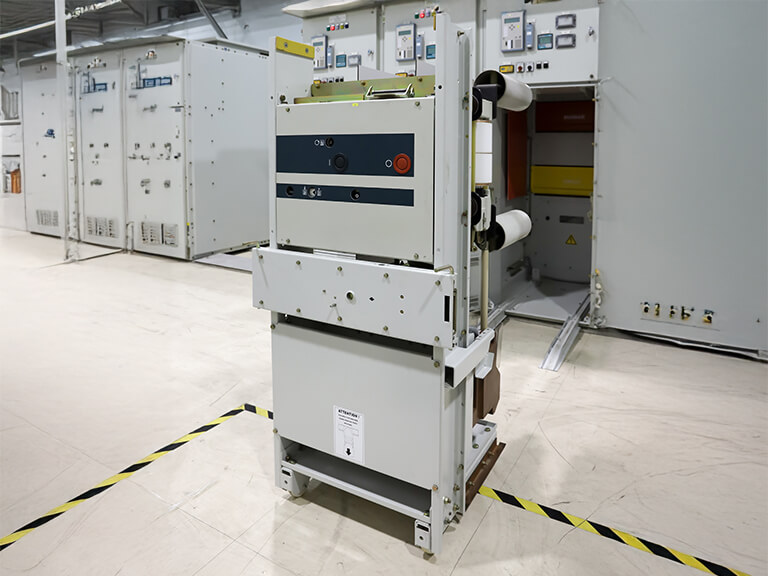
Testing Magnetically Actuated Vacuum Circuit Breakers: Concepts Engineers Must Understand
Vacuum circuit breakers with magnetic actuation were previously a specialised item; they are now commonly found in medium voltage installations where fast response, compact design, and repeatable operation matter more than ever.
These devices replace mechanical parts of conventional switching devices (such as springs) with magnetic actuators, simplifying the mechanical side of switching.
However, this added ease-of-installation may create potential performance pitfalls for users of these devices, as magnetic actuators operate differently than conventional switches. Thus, testing magnetically actuated vacuum circuit breakers needs a slightly different approach.
What Makes Magnetically Actuated VCBs Different
Traditional VCBs depend on stored mechanical energy. Springs are charged, released, and recharged with every operation. In magnetically actuated VCBs, the motion comes directly from an electromagnetic actuator.
That single change affects several things at once:
- The actuator responds instantly to electrical input.
- Opening and closing speed depend on coil current behaviour.
- Mechanical wear follows a different pattern than spring-driven systems.
Because of this, magnetically actuated vacuum circuit breaker testing cannot focus only on movement. Electrical behaviour and magnetic response need equal attention.
Why Testing Magnetically Actuated Vacuum Circuit Breakers Is Critical
Magnetic actuator testing in VCBs begins with one important question: Can you count on the electrical input to produce a mechanical force reliably?
Testing in medium-voltage systems will help an engineer determine if they can count on their coil and actuator currents to function as intended. Testing also helps identify misalignment or movement issues before problems occur.
A small deviation in a medium voltage system can impact protection coordination and fault clearing.
Key Areas of Magnetically Actuated Vacuum Circuit Breaker Testing
1. Magnetic Actuator Performance
At the core of magnetic actuator testing in VCBs is one question: Does electrical input reliably translate into mechanical force?
Engineers typically look at:
- Coil current magnitude and waveform.
- Actuation response time.
- Stability of holding force in the closed position.
Irregularities here almost always show up later as timing or endurance problems.
2. Timing and Synchronisation
Vacuum circuit breaker actuator testing always includes timing, but with magnetic actuators, timing carries more weight.
This usually involves measuring:
- Opening time.
- Closing time.
- Contact bounce or rebound.
Consistent timing confirms that the actuator responds predictably under normal operation as well as fault conditions.
3. Mechanical Movement Analysis
Magnetic actuation reduces moving parts, but it doesn’t eliminate mechanical stress altogether.
Typical VCB testing procedures include:
- Contact travel measurement.
- Velocity and motion profiling.
- Detection of friction or abnormal resistance.
Movement analysis often reveals issues that current measurements alone won’t catch.
4. Dielectric and Insulation Verification
Even though the actuator is electromagnetic, the interrupter remains vacuum-based. Insulation performance still matters.
Testing generally includes:
- HiPot testing.
- Dielectric withstand checks.
- Verification of insulation coordination.
These steps ensure the breaker can operate safely at its rated voltage.
5. Endurance and Mechanical Cycling
One of the key selling points of magnetic actuators is reduced mechanical fatigue. That claim still needs validation.
Mechanical endurance tests simulate:
- Thousands of open and closed operations.
- Repeated actuation under controlled conditions.
- Performance drift over time.
This is a fundamental requirement across magnetic actuator VCB test standards.
Standards Applicable to Magnetically Actuated VCB Testing
There isn’t a separate standard written specifically for magnetic actuators. The test protocol for vacuum circuit breakers adheres to IEC (International Electrotechnical Commission) standards and the comparable national standards of each country and has a defined minimal set of tests, performance, and acceptance standards with the same limits on performance, irrespective of how the circuit breaker is activated.
Commonly applied references include:
- IEC 62271-100 for high-voltage AC circuit breakers.
- IEC 62271-1 for general switchgear requirements.
- Corresponding IS standards are aligned with the IEC for Indian installations.
How Testing Magnetic and Spring Actuators Differs
In practice:
- Spring-based systems focus more on stored mechanical energy and release.
- Magnetic actuators demand closer scrutiny of coil current and response timing.
- Timing stability in magnetic systems is more sensitive to electrical input quality.
- Endurance testing prioritises consistency rather than fatigue alone.
Applying spring-based test logic to magnetic actuators often leads to incomplete evaluation.
The Role of Integrated Testing Systems
Modern breaker designs don’t lend themselves well to fragmented testing. Electrical, mechanical, and insulation behaviour are closely linked.
This is where Crest Test Systems supports manufacturers through its AutoScan Circuit Breaker Test System. The system allows engineers to perform:
- Breaker timing analysis.
- Coil and motor current measurement.
- Mechanical movement tracking.
- HiPot insulation testing.
- Endurance and mechanical cycling.
- Operating force measurements.
All within a single test environment. For magnetically actuated VCBs, this integrated approach simplifies compliance with VCB testing procedures and improves repeatability.
Conclusion
Magnetically actuated vacuum circuit breakers bring real advantages, but they also raise the bar for testing. The functional association between electrical input, magnetic force, and mechanical movement is very strong; thus, for each operation to function properly, these three must all work together to achieve reliable results.
This is where Crest Test Systems takes structured testing from conceptual to real-world implementation, providing manufacturers and testing laboratories with the ability to validate the performance of a magnetic circuit breaker beyond simple compliance.
Whether you are evaluating magnetically actuated VCBs or enhancing your test cycle methodology to meet the demands of emerging applications, Crest Test Systems is there to help you define and gain confidence during each test.
FAQs:
It is a vacuum circuit breaker that uses an electromagnetic actuator instead of a spring mechanism for opening and closing operations.
Because actuator performance depends on electrical and magnetic behaviour, testing ensures consistent timing and reliable operation.
The test will consist of measuring coil current, analysing the timing of the actuator, tracking the movement of the actuator, and performing endurance cycling of the actuator.
IEC 62271 series standards and aligned IS standards govern testing requirements.
The test simulates long-term operation of the actuator by simulating thousands of open/close cycles to verify the stable long-term performance of the actuator.
The testing of magnetic actuators requires more extensive electrical analysis of the actuator and timing than spring actuators, which primarily requires measuring potential mechanical stored energy and releasing it at the correct time.