


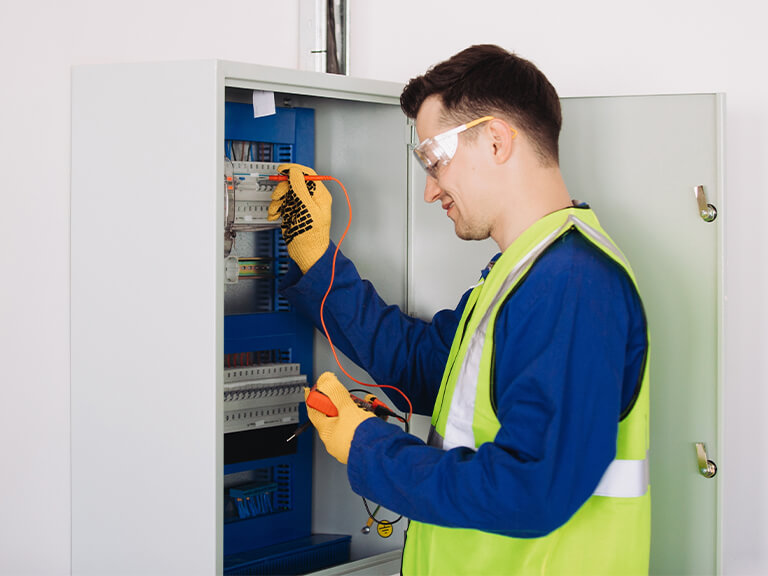
Types of Tests Performed on Circuit Breaker Panels
A circuit breaker panel is the control centre of any electrical installation. It routes power, protects downstream equipment, and isolates faults before they become larger problems. In industrial settings, that responsibility is significant. A panel that looks intact and hasn’t tripped in months isn’t necessarily a panel that’s performing correctly.
That’s the problem with circuit breaker panels. Degradation is gradual, often invisible, and only becomes obvious when something fails under load. Regular circuit breaker panel testing is how you stay ahead of that.
Here’s a breakdown of the tests that actually matter, what each one is checking for, and why skipping any of them creates gaps in your maintenance programme.
1. Visual and Mechanical Inspection
Before any instrument touches the panel, a thorough visual inspection establishes the baseline. Technicians look for signs of overheating, corrosion, physical damage, and loose connections. Arc marks, discolouration around terminals, and worn insulation — these all point to problems that testing will then quantify.
A visual check catches things that test results alone won’t tell you. A burnt terminal might pass a continuity test and still be a failure waiting to happen.
2. Insulation Resistance Testing
Insulation resistance testing is one of the most common circuit breaker maintenance tests, and for good reason. It applies a DC voltage across the insulation between conductors and measures how much current leaks through. What you’re looking for:
- Healthy insulation resists that current. A high resistance reading means the insulation is doing its job.
- Degraded insulation lets current bleed through, showing up as a low or declining resistance value.
- Moisture, heat cycling, and age are the main culprits, and all three act slowly enough that you won’t notice without regular testing.
3. Contact Resistance Measurement
Contacts are where the actual switching happens, and they wear. Every operation leaves a small amount of residual damage on contact surfaces. Over thousands of cycles, that adds up. What high contact resistance actually means in practice:
- Increased resistance generates heat at the contact point.
- That heat accelerates insulation breakdown in the surrounding components.
- What eventually looks like a sudden failure usually has weeks or months of degradation behind it.
Contact resistance measurement runs a high current through the closed contacts and measures the voltage drop. A reading outside the manufacturer’s spec is an early warning that maintenance can still address cleanly.
4. Timing Tests
A circuit breaker that interrupts a fault two cycles late is not the same as one that responds instantly. Timing analysis is a core part of industrial electrical panel testing because mechanical wear shows up here before it shows up anywhere else. The test measures:
- How long does the breaker take to open under a trip signal.
- Close time for the return operation.
- Consistency across multiple operations. A drift between cycles is often the first indicator that something is changing internally.
Catching timing drift during a scheduled circuit breaker panel test is far preferable to discovering it during an actual fault event.
5. Coil and Motor Current Testing
The trip and close coils drive the breaker’s mechanical operation. Coil current testing measures the current drawn during each sequence and compares it against the expected profile. A few things this picks up that visual inspection won’t:
- A coil drawing more current than it should, indicating mechanical resistance somewhere in the drive mechanism.
- Inconsistent current draw across operations, which suggests an intermittent fault in the control circuit.
- Low current draw, which can indicate a coil that’s partially failed and may not complete a trip operation under real fault conditions.
This test gets skipped in a lot of basic maintenance programmes. That’s a mistake because a breaker with a failing trip coil looks completely normal until it doesn’t operate when it needs to.
6. Mechanical Operation and Endurance Testing
Industrial circuit breakers operate far more frequently than most maintenance schedules account for. Automated systems cycle breakers repeatedly, and each operation adds mechanical wear. Endurance testing works through a defined number of operations and checks whether performance holds throughout. What it’s looking for:
- Timing drift that appears after repeated operations.
- Mechanical components that pass a single-cycle test but degrade under sustained use.
- Whether the breaker still meets spec after the kind of workload it actually faces in service.
A breaker that performs well on one test cycle but drifts out of spec after fifty is not a reliable breaker.
7. HiPot (High Potential) Dielectric Testing
HiPot testing applies a high voltage across insulation to verify that it can withstand the electrical stress it will face in service. Unlike insulation resistance testing, which identifies degradation already present, HiPot confirms the insulation will hold under the conditions the panel was designed for. It’s used at three main points:
- During acceptance testing before commissioning.
- After significant repair or replacement work on the panel.
- In periodic maintenance cycles for industrial panels in demanding environments.
The test is a pass or fail. Either the insulation holds under the applied voltage, or it doesn’t, which is exactly the kind of clear result that’s useful before a panel goes into service.
Where Crest Test Systems Fits In
Running all of these tests properly requires either multiple separate instruments or a platform that brings them together. Separate instruments create coordination problems: data in different places, formats that don’t align, and results that are harder to act on consistently.
Crest Test Systems‘ Panel Test System runs the full range of breaker panel tests through one integrated platform:
- Circuit breaker timing.
- Coil and motor current measurement.
- Mechanical movement analysis.
- Contact resistance measurements.
- Endurance and mechanical cycling.
One system, consistent data formats, and results reviewable across test types without switching instruments or reconciling mismatched reports. For facilities running large volumes of industrial electrical panel testing, that consistency directly affects how useful the data is and how quickly maintenance decisions get made.
Conclusion
Circuit breaker panel testing isn’t a single test. It’s a set of complementary checks that together give you a complete picture of panel health. Each one targets a different failure mode, and each one catches something the others won’t.
The facilities that avoid unplanned outages aren’t necessarily the ones with the newest equipment. They’re the ones testing what they have, consistently and completely.
FAQs:
The main tests are insulation resistance testing, contact resistance measurement, timing analysis, coil and motor current testing, mechanical endurance testing, and HiPot dielectric testing. Each targets a different failure mode.
Panels degrade gradually and rarely give obvious warning signs before a failure. Testing catches that degradation early, before it causes downtime or damage to downstream equipment.
It depends on how critical the panel is and how intensively it operates. High-frequency industrial applications need more regular testing than standard installations, with condition-based monitoring increasingly preferred over fixed schedules.
It measures how effectively insulation between conductors resists electrical current, identifying breakdown caused by age, moisture, or thermal stress before it develops into a fault.
Degradation goes undetected. The risk of unexpected failures, unplanned downtime, and equipment damage increases, all of which a basic testing programme would have flagged well in advance.
Yes. Catching issues like high contact resistance or coil degradation early means the fix is still straightforward, rather than after secondary damage has already spread to other components.